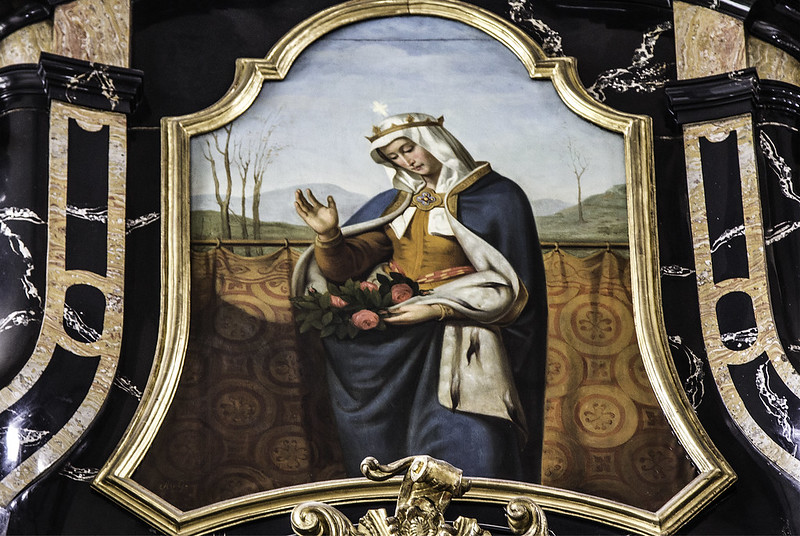


Become a Helper of Jesus to carry His Cross

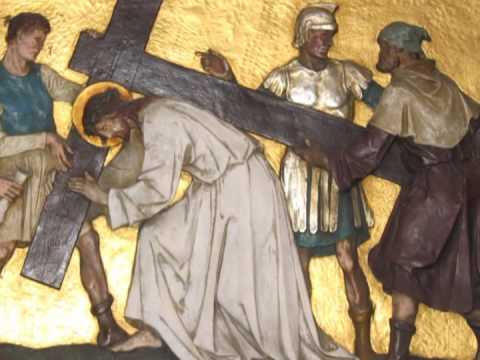
The 5th Station of the Cross depicts Simon of Cyrene being compelled to help Jesus carry the cross. While Jesus is struggling under the weight of the cross, Roman soldiers force
Simon, a passerby, to assist him. This station highlights themes of suffering, compassion, and the unexpected ways God works through other
Simon of Cyrene is remembered in the Bible as the man who helped Jesus carry His cross on the way to His crucifixion. His story is brief but powerful, symbolizing the call to share in Christ’s suffering and mission.
- Biblical Account Simon is mentioned in three of the four Gospels:
• Matthew 27:32 “As they went out, they found a man of Cyrene, Simon by name. They compelled this man to carry his cross.”
• Mark 15:21 “And they compelled a passer-by, Simon of Cyrene, who was coming in from the country, the father of Alexander and Rufus, to carry his cross.”
• Luke 23:26 “And as they led him away, they seized one Simon of Cyrene, who was coming from the country, and laid on him the cross, to carry it behind Jesus.”
“Whoever does not carry his own cross and come after me cannot be my disciple.” — Luke 14:27
2. Spiritual Meaning
Simon of Cyrene represents all of us who are called— sometimes unexpectedly—to help carry the burdens of others. In doing so, we meet Christ, and our lives are transformed.
Unexpected Grace:
Simon’s act, though involuntary, becomes a moment of grace and a symbol of how God uses ordinary people for extraordinary purposes.
Reflection:
The 5th Station invites reflection on how we respond to the needs of others and how we might be called to help carry burdens

 1201 Saint Simon of Cyrene 2p LETTER 20250723
St Simon of Cyrene – 1st December
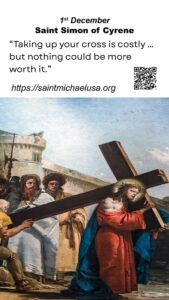
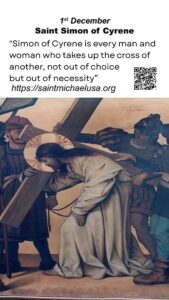
“Taking up your cross is costly … but nothing could be more worth it.”
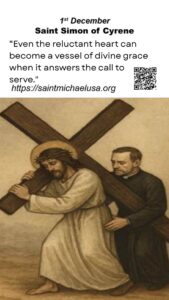
“Even the reluctant heart can become a vessel of divine grace when it answers the call to serve.”
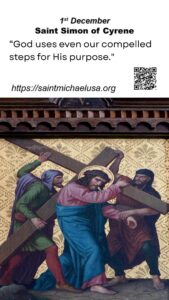
“God uses even our compelled steps for His purpose.”
“Simon of Cyrene is every man and woman who takes up the cross of another, not out of choice but out of necessity”
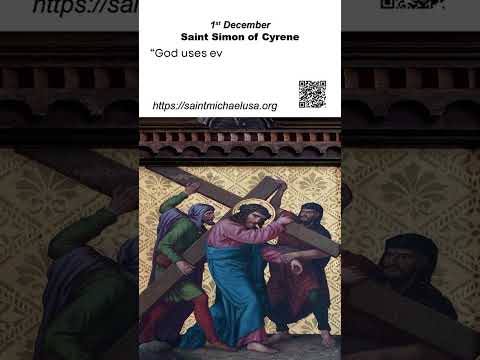
 https://youtube.com/shorts/FbN8tJDRpAM
A Prayer to Simon Of Cyrene
GOOD Saint, tradition says that you were a farmer. If so, you knew what it meant to work hard in the fields day after day. You carried your cross of labor patiently, without complaint or grumbling. You were grateful to the Lord of the harvest when He blessed your work with abundant crops. And you did not lose your trust in Him when He limited His blessings, giving you only a small return for your labors. And our good Lord blessed you, choosing you personally to help Him carry His cross to Calvary.
Dear Saint, teach us to realize that we too can carry the cross of Christ. Teach us to unite our labors and sufferings with the labors and sufferings of our Lord Jesus Christ, offering what we do in union with Him to God, the Father of us all. In this way we can gain great graces for ourselves and for the whole world.
Teach us, too, good Simon, to bring up our children according to God’s laws, as you did Yours Help us to be satisfied with our lot, in the assuring knowledge that the toil of the farmer is needed for the good of the nation and the world, and in itself is noble and honorable. Amen.
Prayer to imitate St Simon of Cyrene
Heavenly Father, whose most dear Son, as He walked the way of the Cross, accepted the service of Simon of Cyrene to carry his physical burden for him: grant us each the grace gladly to bear one another’s burdens, for the love of him who said, “As you did it to the least of these my brethren, you did it to me,” your Son Jesus Christ our Lord, who now lives and reigns with you and the Holy Spirit, one God, now and forever. Amen.
PRAYER TO SHARE THE CROSS
Lord, you opened the eyes and heart of Simon of Cyrene, and you gave him, by his share in your Cross, the grace of faith. Help us to aid our neighbours in need, even when this interferes with our own plans and desires. Help us to realize that it is a grace to be able to share the cross of others and, in this way, know that we are walking with you along the way. Help us to appreciate with joy that, when we share in your suffering and the sufferings of this world, we become servants of salvation and are able to help build up your Body, the Church.
PRAYER TO BE CALLED

Simon just happened to pass there on his way home from the fields. He was forced to make a detour – a detour that changed the course if his life. Forced to carry your cross, Lord Jesus, he himself became a victim of oppression and injustice. He experienced a share of your pain, Lord, and thus discovered what life can be if one wants to help others. Send us more Simon of Cyrene, Lord. Send us people who have the courage to shoulder the crosses of others in brotherly solidarity and patience. Make us like Simon, Lord. Grant us the strength and generosity to carry one another’s burden, for our society is crowded with poor Christs crushed by crosses of all shapes and weights. Amen.
Prayer for carrying the Cross
O my God, I thank you for this cross you have allowed me to carry. Please give me the strength and faith to persevere so that I may bring glory to your name while withstanding the burden of its weight. Thank you for offering me a share in your suffering.
General prayer for strength:
“O Lord Jesus Christ have mercy on me! Mary and Joseph pray for me. Lord Jesus Christ, through Your suffering the Cross grant me strength to bear my Cross without fear or dread and give me the grace that I may follow You. Amen.”
Reflection on Jesus’s suffering:
“My beloved Jesus, it is not the weight of the Cross, but my sins, which have made Thee suffer so much pain. Ah, by the merits of this first fall, deliver me from the misfortune of falling into mortal sin. I love Thee, O my Jesus, with my whole heart; I repent of having offended Thee. Never permit me to separate myself from Thee again.”
Prayer while assisting someone carrying a cross:
“Lord, there are so many people who are carrying crosses. Strengthen us to help carry the load by sharing what we have. Help us to share Your name through action with those who feel abandoned.”
Prayer for carrying one’s own cross:
“My most beloved Jesus, I embrace all the sufferings you have destined for me until death. I beg you by all you suffered in carrying your cross to help me carry mine with your perfect peace and resignation. I love you Jesus, my love, I repent of ever having offended you. Never let me separate myself from you again. Grant that I may love you always and then do with me as you will.”
Saint Simon of Cyrene – 1st December
Simon of Cyrene is one of the most poignant minor figures in the Gospel accounts of the Passion of Jesus Christ. Though mentioned only briefly in the three Synoptic Gospels, his forced act of carrying the Cross has made him an important figure in Christian devotion, especially during the Stations of the Cross (Fifth Station).
Biblical References
- Matthew 27:32
- Mark 15:21
- Luke 23:26
The accounts are almost identical:
“As they were going out, they met a Cyrenian named Simon; this man they pressed into service to carry his cross.” (Matthew) “They pressed into service a passer-by, Simon, a Cyrenian… to carry his cross.” (Mark) “They seized one Simon of Cyrene… and laid the cross on him to carry behind Jesus.” (Luke)
Only Mark adds the important detail that Simon was “the father of Alexander and Rufus” (Mark 15:21). This suggests that Alexander and Rufus were known to the early Christian community in Rome (to whom Mark was writing), meaning Simon’s family later became prominent Christians.
Who Was Simon?
- From Cyrene: A Greek city in present-day Libya (North Africa) that had a large Jewish colony.
- Many Jews from Cyrene lived in Jerusalem or made pilgrimages there, especially for Passover.
- Simon was almost certainly a Jew of the Diaspora who had come to Jerusalem for the Passover feast.
- He was described as “coming in from the country” (Mark & Luke), meaning he was entering the city from the countryside or suburbs when the Roman soldiers seized him.
The Event
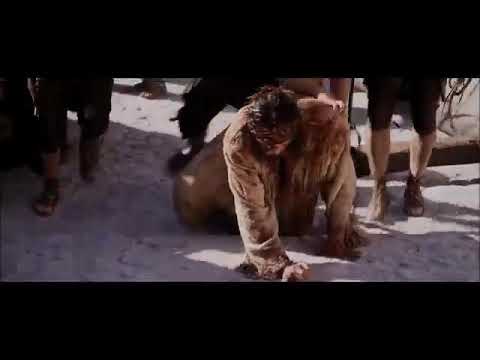
- Jesus, after being scourged and crowned with thorns, was too weakened to carry the full crossbeam (patibulum) the entire way to Golgotha.
- Roman soldiers had the legal right to compel any subject (especially a provincial or foreigner) to perform a task (in Latin, angareia).
- Simon was randomly forced to carry the cross behind Jesus (Luke 23:26).
- Tradition (not Scripture) holds that this encounter profoundly converted Simon and that he walked so close behind Jesus that the blood and sweat of Christ fell on him.
Later Tradition and Devotion
- Early Church Fathers (e.g., St. Ephrem the Syrian, St. John Chrysostom) and medieval tradition believed Simon became a Christian and even a martyr.
- The presence of his sons Alexander and Rufus in Mark’s Gospel strongly suggests the family became active members of the early Church.
- Some traditions identify Rufus with the person greeted by St. Paul in Romans 16:13: “Greet Rufus, eminent in the Lord, also his mother and mine.”
- Simon is venerated as a saint in both the Catholic and Orthodox Churches.
- Feast days:
- Western (Catholic) Church: traditionally with the Finding of the Cross (May 3) or locally on Good Friday
- Eastern Orthodox: July 29 (with St. Silvanus) or December 8 in some calendars
- He is the patron saint of:
- Passers-by
- Those who carry burdens
- Tannery workers and laborers (popular tradition in some regions)
Iconography and the Stations of the Cross
Simon is always depicted in art helping Jesus carry the Cross (often shown taking the weight of the crossbeam on his shoulder while Jesus walks ahead or beside him). In the traditional Stations of the Cross, the Fifth Station is titled “Simon of Cyrene helps Jesus carry the Cross.”
Spiritual Meaning
Simon represents every Christian who is “compelled” at first to take up the Cross, but then freely chooses to follow Christ. His story shows that grace can come even through forced or unexpected suffering, and that walking behind Jesus (literally and spiritually) transforms a person.
Though we know almost nothing else about him, Simon of Cyrene has become an enduring symbol of reluctant yet transformative discipleship.
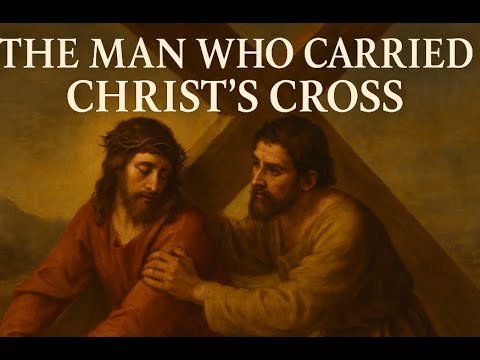
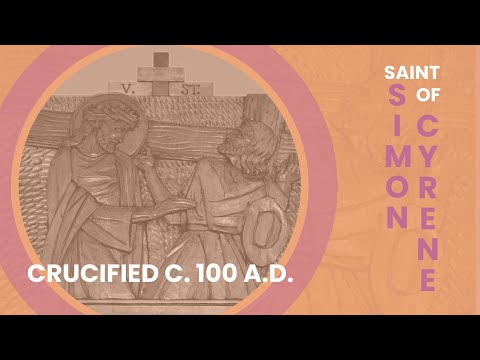


Stay connected — subscribe today
https://www.youtube.com/@st.michaelusa
SIGN UP SO YOU CAN GET A BLESSING !
https://stmichaelcenter.flocknote.com/StMichaelCenter
FOLLOW US ON FACEBOOK !

https://www.facebook.com/StMichaelCenter/
MAKE A DONATION SUPPORT YOUTH & ACTIVITIES