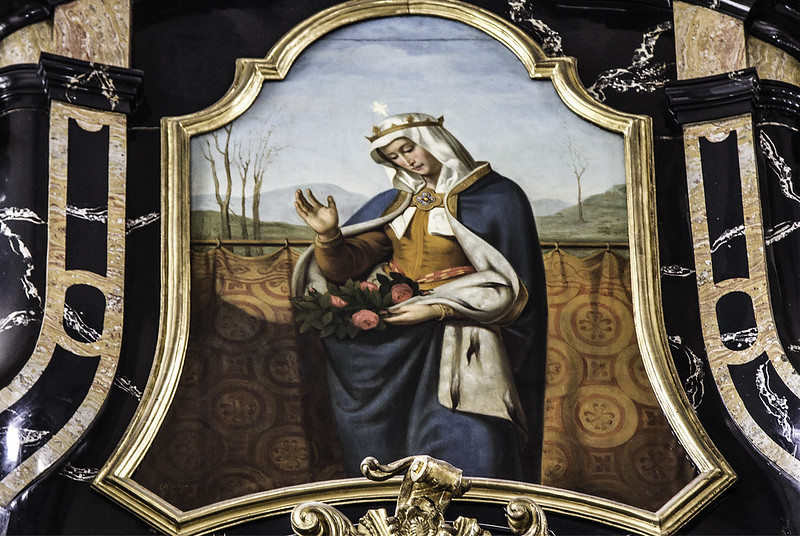

Saint Ignatius of Loyola
He was born on October 23, 1491 at the castle in Loyola in the municipality of Azpeitia, now in Spain. His baptismal name was Inigo Lopez de Loyola. He was brought up by the wife of a local blacksmith since his mother died soon after his birth. He became a servant
in the house of the Treasurer of the Kingdom of Castle, who was a relative to him. In 1509 he joined the army of Viceroy of Navarre and participated in many battles without incurring any injuries to him. But one day he was injured seriously in his legs by a cannonball in a battle on May 20, 1521. During the treatment period he read De Vita Christi, a commentary on the life of Jesus and commentary on the Gospels. After reading this book, he started reading other books about Jesus and other saints. He got a mind change after reading Christian books and decided to devote his life to work for the conversion of non-Christians to Christian faith, in the Holy Land. After recovery from the leg injuries, he went to the Benedictine monastery, Santa Maria de Montserrat on March 25, 1523 and hung his military vestments before the image of the Holy Virgin Mary and went away. He then spent the next few months in a cave and practiced rigorous asceticism. He made a pilgrimage to the Holy Land for about 20 days and he studied in the University of Paris. In Paris he gathered six of his friends namely Francis Xavier, Alfonso Salmeron, Diego Laynez, Nicholas Bobadilla (all Spanish), Peter Faber (French) and Simao Rodriques (Portugal) and they took solemn vows of Poverty, Chastity and Obedience, on August 15, 1534 and about their life long work, in the crypt of the church of Our Lady of Martyrs at, Montmartre, Loyola. They founded the Society of Jesus in 1539. He wrote the constitution of the Society of Jesus and was approved by pope Paul-III on September 27, 1540. St. Ignatius and his friends pronounced their vows in the newly found Order (The Society of Jesus) on April 22, 1541 at the church of St. Paul outside the Walls. St. Ignatius became the first Superior General (Father-General) of the Society of Jesus. The Jesuit motto is ‘Ad Maiorem Dei glorium’ (for the greater glory of God). St. Ignatius of Loyola died on July 31, 1556 in Rome due to malarial fever. He was beatified on July 27, 1609 by pope Paul-V and canonized by pope Gregory-XV on March 12, 1622.

 0731 St Ignatius of Loyola 1p LETTER 20250713
St Ignatius of Loyola – 31st July


 https://www.youtube.com/embed/Fy99h5P4WtQ
“Go forth and set the world on fire.”
“Act as if everything depended on you; trust as if everything depended on God.”
“God gives each one of us sufficient grace ever to know His holy will, and to do it fully.”
“Try to keep your soul always in peace and quiet, always ready for whatever our Lord may wish to work in you.”
Prayer of St. Ignatius


“Take, Lord, receive all my liberty, my memory, my understanding, my whole will, all that I have and all that I possess. You gave it all to me, Lord; I give it all back to you. Do with it as you will, according to your good pleasure. Give me your love and your grace; for with this I have all that I need.”
A Favorite Prayer of St. Ignatius of Loyola – THE ANIMA CHRISTI

Soul of Christ, sanctify us.
Body of Christ, save us.
Blood of Christ, inebriate us.
Water from the side of Christ, wash us.
Passion of Christ, strengthen us.
O Good Jesus, hear us.
Within your wounds hide us.
Separated from you let us never be.
From the wicked enemy, defend us.
At the hour of death, call us
and bid us come to you,
that with your saints we may praise you
forever and ever.
Amen.
Saint Ignatius of Loyola
Feast Day: July 31
Patron Saint of: Soldiers, spiritual retreats, and the Society of Jesus (Jesuits)
Born: 1491, Loyola, Spain
Died: July 31, 1556, Rome, Italy
Canonized: March 12, 1622, by Pope Gregory XV
His Story
St. Ignatius of Loyola was a Spanish soldier who experienced a powerful spiritual conversion after being seriously wounded in battle. While recovering, he read books about the life of Christ and the saints, which awakened in him a desire to serve God more completely.
He gave up his military career and began a pilgrimage of the soul, focusing on prayer, penance, and spiritual growth. His deep reflection led to the creation of the Spiritual Exercises, a powerful method of discernment and devotion still used around the world today.
In 1534, he and a small group of companions (including St. Francis Xavier) founded the Society of Jesus (Jesuits)—a religious order devoted to education, missionary work, and defending the Catholic faith.
Key Themes
- Conversion: From soldier of the world to soldier for Christ.
- Discernment: Learning to recognize God’s voice in everyday life.
- Missionary Zeal: The Jesuits became leaders in education, science, and evangelization worldwide.
- Spiritual Exercises: A guide for personal retreat and spiritual growth, emphasizing silence, meditation, and action.
Famous Quotes by St. Ignatius of Loyola
“Go forth and set the world on fire.”
“Take, Lord, and receive all my liberty, my memory, my understanding, and my entire will…”
“Act as if everything depended on you; trust as if everything depended on God.”
Prayer of St. Ignatius (Suscipe)
Take, Lord, and receive all my liberty,
my memory, my understanding, and my entire will,
All I have and call my own.
You have given all to me. To you, Lord, I return it.
Everything is yours; do with it what you will.
Give me only your love and your grace, that is enough for me.
From Soldier to Saint: The Life of St. Ignatius of Loyola
Early Life
Iñigo López de Loyola was born in 1491 in the Basque region of northern Spain, the youngest of thirteen children of a noble family. He was raised with the ideals of chivalry, honor, and military valor. As a young man, he served as a page in the royal court and pursued the life of a Spanish gentleman — ambitious, vain, and enamored with worldly glory.
The Cannonball That Changed Everything
In May 1521, during the Battle of Pamplona, a cannonball shattered Ignatius’s right leg. During his long and painful recovery at the castle of Loyola, he asked for his beloved chivalric romances to pass the time — but none were available. The only books on hand were a Life of Christ and a collection of lives of the saints.
Reluctantly at first, he began to read. What followed was one of the most celebrated conversions in Church history.
As he read, he noticed something remarkable happening within himself. When he daydreamed about worldly glory — knights, battles, romance — he felt a rush of pleasure that quickly faded, leaving him dry and empty. But when he imagined imitating the saints — “What if I did what St. Francis did? What if I did what St. Dominic did?” — he felt a deep and lasting consolation.
This simple but piercing observation became the seed of what would grow into the Discernment of Spirits — one of the greatest gifts Ignatius ever gave to the Church.
Conversion and Early Pilgrimage
After his recovery, Ignatius made a pilgrimage to the Benedictine monastery of Montserrat, where he made a general confession of his entire life, spent a night of vigil before the Black Madonna, and hung up his sword at her altar — the gesture of a knight surrendering his weapons to his new Lady. It was an act of profound symbolic power.
He then spent nearly a year in the nearby town of Manresa, living in extreme poverty, prayer, and penance — frequently visiting a cave along the Cardoner River. There, in a moment of mystical illumination beside that river, he received what he himself described as the greatest spiritual light of his life, understanding the mysteries of faith with sudden, overwhelming clarity. The Spiritual Exercises were born from this period of prayer and suffering.
He later made a pilgrimage to Jerusalem — a journey that would later shape his vision for a company of men available to go anywhere the Pope sent them.
The Spiritual Exercises
The Spiritual Exercises are Ignatius’s masterpiece — a structured 30-day retreat (or an adapted “19th Annotation” retreat made over several months in daily life) designed to help a person encounter Jesus Christ personally, order their disordered affections, and discover God’s will for their life.
The Exercises are divided into four “Weeks” (not necessarily seven days each, but stages of interior movement):
Week One: Sin and Mercy
The retreatant meditates on sin — personal sin, original sin, the sin of the angels — not to wallow in guilt but to awaken the soul to its need for redemption. The great fruit of the First Week is sorrow, contrition, and gratitude for God’s mercy. The famous meditation on Hell is not meant to terrorize but to clarify: there are real stakes in how one lives.
Week Two: The Kingdom of Christ and His Life
The retreatant contemplates the life of Christ — from the Incarnation through the public ministry — using Ignatian Contemplation: placing oneself imaginatively within the Gospel scene, engaging all the senses, and listening for what Christ says to the soul personally. The famous meditation on Two Standards — the banner of Christ versus the banner of the enemy — lays bare the spiritual warfare at the heart of human history. The election — the discernment of one’s vocation or life direction — occurs here.
Week Three: The Passion
The retreatant walks with Christ through His suffering and death. The aim is deep compassion — literally suffering with — and a sharing in the Cross. This week purifies any attachment to consolation and deepens the soul’s solidarity with the suffering Christ.
Week Four: The Resurrection
The retreatant contemplates the Risen Lord — His appearances to Our Lady, the disciples, Mary Magdalene. The fruit is joy, gratitude, and love. The Exercises culminate in the Contemplation to Attain Love (Contemplatio ad Amorem) — one of the most beautiful prayers in the entire Catholic tradition, which includes the famous Suscipe:
“Take, Lord, and receive all my liberty, my memory, my understanding, and my entire will…”
The Discernment of Spirits
One of Ignatius’s most enduring contributions to Catholic spirituality is his rules for discernment of spirits — practical, precise guidelines for distinguishing between movements that come from God (consolation) and those that do not (desolation).
Key principles include:
- Consolation is a movement of the soul toward God — increased faith, hope, love, peace, and interior joy.
- Desolation is a movement away from God — darkness, confusion, temptation toward discouragement, a feeling of separation from God.
- Never make a major decision in desolation. The enemy of human nature attacks during weakness; decisions made in desolation are almost always misdirected.
- In consolation, prepare for desolation. Store up the graces of good times to sustain the soul during dry periods.
- The enemy works differently on souls moving toward God versus souls moving away from God. For a soul moving toward God, the enemy attacks through discouragement and anxiety. For a soul moving away from God, the enemy flatters and soothes.
These rules did not come from armchair theology. They came from Ignatius’s own hard-won interior experience — tested, refined, and confirmed over years of prayer.
✝️ Founding the Society of Jesus
After years of study — including at the University of Paris, where he gathered around him the original companions who would become the Society of Jesus — Ignatius was ordained a priest in 1537.
On September 27, 1540, Pope Paul III formally approved the Society of Jesus (the Jesuits) with the bull Regimini Militantis Ecclesiae. The founding document identified the Society’s purpose with extraordinary clarity: the defense and propagation of the faith, the progress of souls in Christian life and doctrine, and service to the Pope with unconditional availability.
The Fourth Vow — a special vow of obedience to the Pope regarding missions — set the Jesuits apart. They were to go wherever the Pope sent them, without delay and without attachment to place, nation, or comfort.
Ignatius served as the first Superior General until his death and spent most of his generalship not traveling but governing from Rome — writing thousands of letters, forming the Constitutions, and directing a rapidly expanding global mission.
Legacy
Under Ignatius and his early companions, the Society of Jesus accomplished staggering things in just a few decades:
- St. Francis Xavier brought the faith to India, Japan, and the edges of China.
- The Jesuits led the Catholic Counter-Reformation, revitalizing the Church’s intellectual and spiritual life.
- Jesuit schools and universities spread across Europe, shaping the minds of countless statesmen, scholars, and saints.
- Jesuit missionaries went to the Americas, Africa, and Asia — often at the cost of their lives.
The Jesuit modus procedendi — their way of proceeding — was marked by: excellence in learning, adaptability in mission, deep interiority combined with active apostolic engagement, and absolute fidelity to the Pope and the Magisterium.


Stay connected — subscribe today
https://www.youtube.com/@st.michaelusa
SIGN UP SO YOU CAN GET A BLESSING !
https://stmichaelcenter.flocknote.com/StMichaelCenter
FOLLOW US ON FACEBOOK !

https://www.facebook.com/StMichaelCenter/
MAKE A DONATION SUPPORT YOUTH & ACTIVITIES