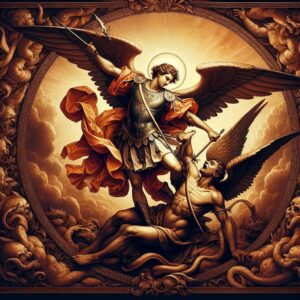
St Michael the Archangel defeating Satan
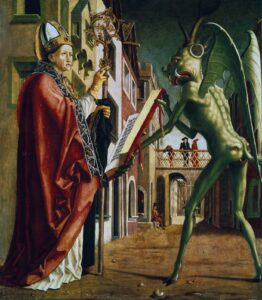
St. Augustine confronting the devil.
In Roman Catholic theology, evil is not a thing created by God, nor is it a force equal to God. Rather, evil is understood as the absence or privation of the good (privatio boni). This understanding was developed especially by Saint Augustine of Hippo and further explained by Saint Thomas Aquinas.
What is evil?
The Catholic Church teaches that:
Evil is the lack of a good that ought to be present.
For example:
- Darkness is the absence of light.
- Blindness is the absence of sight.
- Sin is the absence of the holiness and love that should be present in a person’s actions.
God created everything good:
“God saw everything that he had made, and behold, it was very good.” (Genesis 1:31)
Therefore, evil is not something God created.
The two main kinds of evil
1. Moral Evil
Moral evil results from the free choices of angels and human beings who choose against God’s will.
Examples include:
- Murder
- Theft
- Lying
- Hatred
- Abortion
- Blasphemy
The first moral evil was the rebellion of Satan and the fallen angels, followed by the sin of Adam and Eve.
2. Physical Evil
Physical evil refers to suffering that is not itself a sinful choice, such as:
- Disease
- Earthquakes
- Famine
- Aging
- Death
These entered human experience as consequences of the Fall and the disorder introduced by original sin.
Why does God allow evil?
This is one of Christianity’s deepest questions.
Catholic theology teaches that God allows evil because He has given rational creatures genuine freedom, and because He can bring about a greater good from evil.
Examples:
- Joseph was sold into slavery, yet God used it to save many lives.
- The greatest evil in history—the crucifixion of Jesus Christ—became the means of humanity’s salvation through His Resurrection.
As Romans 8:28 says:
“We know that in everything God works for good with those who love him.”
Is Satan equal to God?
No.
Catholic teaching firmly rejects any idea of two equal opposing powers (dualism).
- God is infinite, eternal, and all-powerful.
- Satan is a created angel who freely rebelled.
- Satan has limited power and remains subject to God’s ultimate authority.
How Catholics overcome evil
Catholics believe Christ has already conquered evil through His Passion, Death, and Resurrection. Christians cooperate with God’s grace by:
- Living in sanctifying grace.
- Receiving the Sacraments, especially the Eucharist and Sacrament of Reconciliation.
- Prayer and fasting.
- Acts of charity and mercy.
- Resisting temptation.
- Trusting in God’s providence.
Key teachings from the Catechism
The Catechism of the Catholic Church teaches:
- God is infinitely good and did not create evil.
- Evil entered creation through the misuse of freedom by angels and human beings.
- God permits evil because He respects freedom and can bring a greater good from it.
- Christ definitively conquered sin and death through His Cross and Resurrection.
A concise Catholic definition
Evil is the privation of the good that ought to exist. It is not a substance or a rival power to God, but a disorder arising from the misuse of freedom or from the consequences of the Fall. God permits evil only because, in His wisdom and providence, He can bring about a greater good through Christ.
This understanding preserves two essential truths of Catholic theology: God is perfectly good and the Creator of all that exists, and evil has no independent existence apart from the corruption or absence of the good.
Catholic Definition of Evil (Authoritative Summary)
Evil is a privation of good
The Catholic Church teaches that evil is not a “thing” with its own existence. It is the absence, lack, or privation of a good that ought to be present.
This comes directly from St. Augustine and St. Thomas Aquinas and is reflected in the Catechism of the Catholic Church (CCC).
Evil is “the privation of a good” that should be there. (St. Thomas Aquinas, echoed in CCC 311–312)
In other words: Evil is a hole where goodness should be.
Moral Evil: Evil caused by human choice
Moral evil is when a person freely chooses something contrary to God’s law.
Examples:
- Sin
- Malice
- Injustice
- Hatred
- Betrayal
- Abuse of freedom
The Catechism teaches:
Moral evil results from the misuse of freedom. (CCC 311)
Human beings cause moral evil when they choose against truth, charity, and God’s will.
Physical Evil: Suffering not caused by sin
Physical evil refers to:
- Illness
- Natural disasters
- Death
- Physical suffering
These are not sins. They are consequences of living in a fallen world.
The Church teaches that God permits physical evil only because He can bring a greater good from it (CCC 312).
Evil is never created by God
God is all-good and cannot create evil.
The Catechism is explicit:
God is in no way, directly or indirectly, the cause of moral evil. (CCC 311)
Evil exists because:
- Angels and humans have free will
- Creation is not yet fully redeemed
- God allows evil only to bring about a greater good
Evil is ultimately defeated by Christ
The Church teaches that Christ’s Cross and Resurrection are the definitive victory over evil.
All evil—moral and physical—will be destroyed when Christ returns.
In One Sentence
Evil, according to the Catholic Church, is the absence of a good that should be present, caused either by misuse of human freedom (moral evil) or by the suffering of a fallen world (physical evil), and never created by God.
In Catholic teaching, evil is not a “thing” with its own independent existence — it’s defined primarily as a privation (an absence or lack) of a good that ought to be present. This idea comes from St. Augustine and St. Thomas Aquinas and remains the Church’s standard framework.
Key points from Catholic doctrine:
Evil is privatio boni (privation of good)
Everything God created is good, since God, who is perfect Goodness, cannot create evil directly. Evil arises when something that should have a certain goodness or perfection lacks it. Blindness, for example, isn’t a “substance” — it’s the absence of sight where sight should be. Moral evil works the same way: sin is a deficiency, a turning away from the good one should have chosen.
Two main categories
- Moral evil (sin): This results from the free choice of rational creatures (angels or humans) to turn away from God and his will. The Catechism of the Catholic Church (CCC 311, 386–387) ties this directly to free will — evil is possible because God allows genuine freedom, without which love and virtue would be meaningless.
- Physical/natural evil: Suffering, disease, death, and natural disasters. These are consequences of living in a finite, material, and (per Catholic theology) fallen world — connected to Original Sin’s disruption of the created order (CCC 400–401).
The Devil and evil
Catholic teaching holds that a personal, created being — Satan and the fallen angels — actively tempts humans toward sin (CCC 391–395). But even Satan’s evil is understood as a privation: a corruption of a nature that was originally good, since he was created good by God and became evil through his own free rejection of God.
Why God permits evil
The Church teaches this is a mystery bound up with free will and God’s providence: God permits evil because he can draw a greater good from it (CCC 311–314), most supremely shown in the Cross and Resurrection, where the greatest evil (the killing of the Son of God) becomes the source of humanity’s redemption.
In short: Evil, per Catholic theology, is the absence or corruption of the good that should exist in a person, action, or nature — not a rival force equal to God, but a wound or void in creation stemming from the misuse of free will by angels and humans.


Stay connected — subscribe today
https://www.youtube.com/@st.michaelusa
SIGN UP SO YOU CAN GET A BLESSING !
https://stmichaelcenter.flocknote.com/StMichaelCenter
FOLLOW US ON FACEBOOK !

https://www.facebook.com/StMichaelCenter/
MAKE A DONATION SUPPORT YOUTH & ACTIVITIES

https://saintmichaelusa.org/make-a-donation/