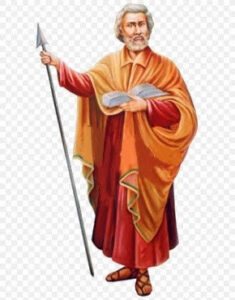

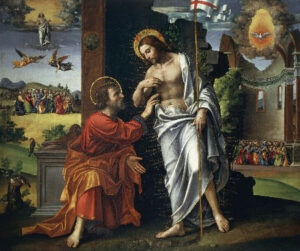
Feast day of St. Thomas in Roman and Syrian Catholic churches is on 3rd July. In addition, the next Sunday of the Easter (Pascha) is celebrated as Sunday of Thomas, in commemoration of Thomas’ question to Jesus which led him to proclaim, ‘My Lord and My God’ and the day in Kerala is known as Puthunjayar. Thomas is also commemorated in common with all of the other apostles on June 30, in a feast called the Synaxis of the Holy Apostles. Thomas is considered to be the patron saint of architects, builders, carpenters, construction workers, geometricians, masons, stone masons, stone cutters, surveyors, theologians, people who have doubts in faith and blind.
Prayer to St. Thomas the Apostle
O St. Thomas, the Apostle of India, Father of our faith, you spread the light of Christ in the hearts of the people of India. You humbly confessed “My Lord and My God” and sacrificed your life for love of him. We pray to you to strengthen us with love and faith in Jesus Christ so that we may dedicate ourselves totally to the cause of the kingdom of justice, peace and love. We pray that through your intercession we may be protected from all trials, dangers and temptations and be strengthened in the love of the Triune God, Father, Son and the Holy Spirit.
Amen
 0703 St Thomas Apostle 2p LETTER R1R 20260227


“Let us also go, that we may die with him.”
“Lord, we know not where thou goest; and how can we know the way?”
“Unless I see … and put my hand into his side, I will not believe.”
“The disbelief of Thomas has done more for our faith than the faith of the other disciples.”
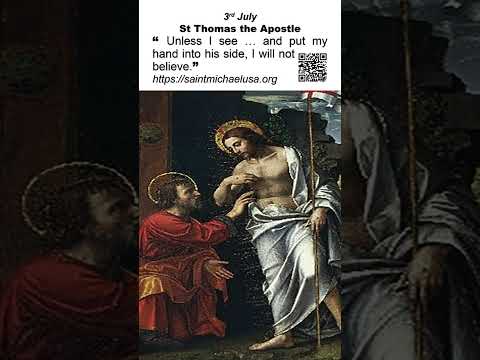
 https://www.youtube.com/embed/ZL1ll4NHwtE
 Prayer to St. Thomas the Apostle, for Spending Ourselves in His Service
O Glorious St. Thomas, your grief for Jesus was such that it would not let you believe he had risen unless you actually saw him and touched his wounds. But your love for Jesus was equally great and it led you to give up your life for him. Pray for us that we may grieve for our sins which were the cause of Christ’s sufferings. Help us to spend ourselves in his service and so earn the title of “blessed” which Jesus applied to those who would believe in him without seeing him.
Amen
Prayer to St. Thomas the Apostle, for Faith
Almighty and ever living God, who didst strengthen thine apostle Thomas with sure and certain faith in thy Son’s resurrection: Grant us so perfectly and without doubt to believe in Jesus Christ, our Lord and our God, that our faith may never be found wanting in thy sight; through him who liveth and reigneth with thee and the Holy Spirit, one God, now and for ever.
Prayer to St. Thomas the Apostle, for Architects, Buildersand Carpenters
Dear St. Thomas, you were once slow in believing that Christ had gloriously risen; but later, because you had seen him, you exclaimed: “My Lord and my God!” According to an ancient story, you rendered most powerful assistance for constructing a church in a place where pagan priests opposed it. Please bless architects, builds and carpenters that through them the Lord may be honored.
Amen
Prayer to St. Thomas the Apostle, Pray for Me
Lord Jesus, St. Thomas doubted Your resurrection until he touched Your wounds. After Pentecost, You called him to become a missionary in India, but he doubted again and said no. He changed his mind only after being taken into slavery by a merchant who happened to be going to India. Once he was cured of his doubt, You freed him and he began the work You had called him to do. As the patron saint against doubt, I ask him to pray for me when I question the direction in which You are leading me. Forgive me for mistrusting You, Lord, and help me to grow from the experience. Saint Thomas, pray for me.
Amen
Prayer
O glorious Apostle Thomas! who didst lead to Christ so many unbelieving nations, hear now the prayers of the faithful, who beseech thee to lead them to that same Jesus, Who, in five days, will have shown Himself to His Church. That we may merit to appear in His divine presence, we need, before all other graces, the light which leads to Him. That light is Faith; then, pray that we may have Faith. Heretofore, our Saviour had compassion on thy weakness, and deigned to remove from thee the doubt of His having risen from the grave; pray to Him for us, that He will mercifully come to our assistance, and make Himself felt by our heart. We ask not, O holy Apostle! to see Him with the eyes of our body, but with those of our faith, for He said to thee, when He showed himself to thee: Blessed are they who have not seen, and have believed!
Of this happy number, we desire to be. We beseech thee, therefore, pray that we may obtain the Faith of the heart and will, that so, when we behold the divine Infant wrapped in swaddling-clothes and laid in a manger, we may cry out: My Lord! and my God! Pray, O holy Apostle, for the nations thou didst evangelise, but which have fallen back again into the shades of death. May the day soon come, when the Sun of Justice will once more shine upon them. Bless the efforts of those apostolic men, who have devoted their labours and their very lives to the work of the Missions; pray that the days of darkness may be shortened, and that the countries, which were watered by thy blood, may at length see that kingdom of God established amongst them, which thou didst preach to them, and for which we also are in waiting.
Let us Pray!
Glorious Saint Thomas, Your love for Jesus and faith in him as Lord and God are an inspiration for all who seek Jesus. You gave up your life as an Apostle and as a missionary. You encourage us to be courageous in giving witness to faith and in proclaiming the gospel. You lead us to be missionary in our endeavours.
As our patron, pray for us as we build a new catholic church in Clyde North. We ask your intercession that we may spend ourselves in the service of Jesus and his Mission.
Under your watchful care may we grow in faith and generously use our talents, gifts and vision in the service of Christ Jesus and in love for our neighbour.
July 3 Thomas, Apostle of India
ST THOMAS, APOSTLE & ST FRANCIS XAVIER
Cardinal Crescenzio Sepe
Special Envoy of the Holy Father
St Thomas, Apostle 1,950 years ago
St Francis Xaiver 450 years ago
On Sunday, 17 November, in the Cathedral of Ernakulam, Kerala, India, Cardinal Crescenzio Sepe, Prefect of the Congregation for the Evangelization of Peoples, preached the following homily at the Eucharistic Celebration for the 1950th anniversary of the arrival in India of St Thomas the Apostle and the 450th anniversary of the death of St Francis Xavier at the gates of China on 3 December 1552.
The Cardinal recounted the history of the two great missionary saints. He praised the progress of the Church in the Indian sub-continent. “There are thousands of dedicated priests, religious and lay people, in both the Oriental and the Latin Church traditions, who sacrifice their lives to help uplift the poor, the downtrodden and the sick….”
The Cardinal pointed out the great good for evangelization from the deepening of communion between Eastern and Western Churches. “…We thank God for the richness of both the Oriental and Occidental traditions in the Church here, and unite our prayer with the Priestly Prayer of Jesus, ‘that all may be one’” (Jn 17,21).
My dear Brothers and Sisters,
It is with great joy that I am here in Ernakulam, in this beautiful State of Kerala, for the Jubilee celebrations of the two great Apostles of India, St Thomas and St Francis Xavier. As Special Envoy of His Holiness, Pope John Paul II, I assure you of the keen interest the Holy Father takes in this celebration and of his prayers and solidarity, for the Christian community, and for the whole Indian nation, at this milestone in its history.
India is the land of ancient cultures and traditions, with its innate spiritual insight and moral wisdom. It was here that several of the world’s great Religions were born, and where many others were accepted and integrated. Unity in diversity has always been its hallmark, as the different traditions strove to live side by side in a spirit of complementarity and harmony.
The Apostle St Thomas’ arrival in India
The Catholic Church in India traces its origin to the preaching of St Thomas the Apostle, who, according to tradition, came to India in 52 A.D., nearly 2000 years ago, and who was martyred in Mylapore, where his tomb is venerated ever since.
The personality of this great figure, with his own characteristic traits, emerges in the Gospel of St John (Jn 11,16; 14,5; 20,24-29). Together with the other Apostles, he formed an intimate community with Jesus of Nazareth and shared all the joys and trials that accompanied him as he moved around the countryside to preach his message of love and unity. Thomas was an impulsive type of man, zealous in reaching out to others, not afraid to ask questions and seek clarifications when required, who battled with his own resistance and doubts surrounding the extraordinary events of Christ’s death and resurrection in Jerusalem. He is the one who, touching Jesus’ wounds after the resurrection, had all his doubts disappear and his faith moved to a new level. He simply believed, exclaiming from the depths of his heart: “my Lord and my God”. It finally came home to him the full import of what had happened: Jesus Christ had risen from the dead, thus overcoming suffering and death and offering new hope for all humanity. A new era had begun.
Thomas understood his own mission as that of sharing this experience, as in the words of Jesus, “go out to the whole world and proclaim the Good news to all creation”, that is, to proclaim the message and reality of God’s unconditional love to all peoples, regardless of creed or colour, nationality or race. Each of the Apostles set out on the mission assigned them by the Lord: “you will be my witnesses, not only in Jerusalem, but throughout Judea and Samaria, and indeed to the ends of the earth” (Acts 1,8). What was the particular destination of Thomas, and how did he arrive?
East Syrian Liturgical Tradition, example of inculturation
There is no answer to these questions in the New Testament books, but other holy documents and traditions clearly allude to Thomas’ preaching and dying in India, and to the burial of his mortal remains in Mylapore (Chennai).
According to tradition, St Thomas worked for 20 years in Kerala, spreading the Good News, establishing different communities. The St Thomas Christians faithfully preserved the Gospel message throughout the centuries, fully integrating thefaith into the local culture. Because of their inculturation , the Christians of St Thomas were not considered as followers of a foreign Religion; after all, Jesus was an Asian. They were fully Christians in faith and Indian in culture. Thus Christianity was a beautiful and precious stone in the enchanting mosaic of Kerala Society.
The unbroken presence and belief of the St Thomas Christians through two millennia gives witness to the missionary work of this great Apostle. These Christians, with their East Syrian Liturgical tradition, ensured that the message of the Gospel was kept alive and that the memory of the Apostle Thomas would live on to inspire successive generations. Early records of travellers finding isolated Christian communities in India go back as far as 345, nearly a century before St Patrick began the evangelization of Ireland, in North-Western Europe.
We give thanks to the St Thomas Christians for their fidelity to Christ and to his beloved Apostle, Thomas. Through trials and tribulations of all kinds, they remained firm, giving witness to God’s love, which was poured out for his people. Nobody can ignore the substantial contribution that the Church of St Thomas has given, and continues to give, to the evangelization of India and beyond her boundaries. They have proved themselves true sons and daughters of St Thomas, who brought the Gospel message to their forefathers, nearly 2000 years ago.
Portuguese discoverers
The Portuguese were the first Europeans to discover the sea route to India when Vasco da Gama landed in Calicut in 1498. Two years later, on 24 December 1500, Portuguese ships visited Kochi, just across the bay from where we are celebrating this Eucharist.
St Francis Xavier’s arrival, his love for St Thomas
Thus the door was open for St Francis Xavier, one of the first companions of St Ignatius, Founder of the Society of Jesus—the Jesuits—who arrived a few decades later. He set sail for the East, his heart burning with the desire to share the Gospel of Jesus Christ with people of distant lands. He reached Goa on 6 May 1542 but soon headed further south, where he worked unceasingly to bring the Good News to the people, learning the local language, making endless journeys, and never caring for his own health or comfort. After journeys to Thiruvithamcore (Travancore) and other places along the West Coast, he moved east to Mylapore. There, at the grave of the Apostle Thomas, he spent several months in prayer. As a sign of his great devotion to the Apostle he had, already in 1542, introduced the saint’s name in the confessional formula of the Mass. It was after the prayerful days spent at the tomb, enlightened and refreshed by that experience, that Francis set out for his mission in the Far East. Many letters he wrote at that time show his great interest in and concern for the St Thomas Christians and their bishop, Mar Jacob.
Death of St Francis, 3 December 1552 at Sancian
Never having realized his ultimate dream of preaching the Gospel in China, Francis died on 3 December 1552 at Sancian (Shangquan), an island off the Guangdong Coast of China. His body, however, was brought back to Goa where, to this day, it is revered in the church of Bom Jesus.
Francis Xavier is acknowledged by people of all walks of life as a great saint. He was a courageous person, seeking always the will of God. He could deal equally with the high and the low people ofsociety, though his preference was for the poor, the lowly, the suffering and the weak. In his instructions to his companions at work along the Fishery Coast and in Travancore, he urged them to be present to “the heart of the masses” that they encountered in the villages they visited. “Visit those who are sick”, he said, “strive to make yourselves loved by these people, for then your work will be much more effective”. Xavier saw the importance of making himself one with people, of being inculturated. He and his companions spoke to the people in the simple language of the slaves, the merchants, the settlers and the servants. He respected the social customs of the Indians with regard to food, dress and other areas of life, thereby showing his resolve to have Christianity understood from within.
In a few short years, Francis achieved a lot for the Church in India. He set the tone and pace for successive generations of Christians, who would follow the same spirit of selfless service to spread the Good News of Jesus Christ in all parts of the country. The later history of the Church in India is a glorious story of heroic men and women who gave their lives for the love of God and for the people of India.
Mother Teresa of Calcutta lived the Gospel of love
Both St Thomas the Apostle and St Francis Xavier have played a very special role in India’s story. At different points of its history, this land of ancient cultures and deep religious values opened its heart to these two Apostles from distant lands. These two figures were the instruments chosen by God to preach the Kingdom of God, to teach the people in India about the love of God and the love of neighbour. Francis’ fresh approach was built on the solid foundations of a Church that had its roots from apostolic times. Both preached the same Gospel of love, which was readily receivedby the people and which, in later generations, found particular expression in the care of the sick, the handicapped and the abandoned. Mother Teresa of Calcutta, known to all, is just one telling example of this type of evangelization, which has been acknowledged and admired throughout the world. India has honoured her with the highest recognition by conferring on her the “Bharata Rantnam”.
Dedication of Oriental and Latin Churches
There are thousands of dedicated priests, religious and lay people, in both the Oriental and the Latin Church traditions, who sacrifice their lives to help uplift the poor, the downtrodden and the sick. The thousands of schools, hospitals, dispensaries, centres for leprosy patients, homes for the handicapped and aged, run by the Church all over India proclaim every day this Gospel of love. The Church in Kerala, in particular, has in its turn sent thousands of missionaries to share the GoodNews beyond its own territorial limits, both in India and beyond. Vocations to priestly and religious life are a cause of admiration for the entire Catholic Church. This is no doubt due to the strong sense of family values and traditions prevailing in the Kerala Church. The Catholic faith is well preserved and transmitted to the young generations through the faith education imparted in the families, as well as in faith formation groups managed by committed lay people and religious.
This land, which received Thomas and Francis, and which produced many other great saints, faces into the third Millennium with gratitude for the past and with hope for the future. Every age has its particular emphasis and focus, and the occasion of this Jubilee can help all to tune into the universal concerns of the Church, as she embarks on the journey into the Third Millennium. At the end of the Great Jubilee 2000, the Holy Father said that the great challenge is to make the Church the home and school of communion. We must gratefully acknowledge this gift of communion that India has been trying to foster down through the centuries and we must focus more on ways and means of fostering and strengthening a sense of communion both within the Church and with people of all traditions and religions.
Greater sense of communion will foster evangelization
While numerically a small minority in a vast population, just like the little mustard seed in the parable of Jesus, the Catholic Church in India is nevertheless an inspiring and compelling sign of the Kingdom of God, championing the cause of all, especially the poor and the marginalized. Its credibility will be all the greater, to the extent that the communion among all Catholics is enhanced and finds greater expression. We thank God for the richness of both the Oriental and Occidental traditionsin the Church here, and unite our prayer with the Priestly Prayer of Jesus, “that all may be one” (Jn 17,21). Solidarity and collaboration between the different Churches (cf. Ecclesia in Asia, n. 26), and the “dialogue of life and heart” with other religions (cf, Ecclesia in Asia, n. 31) must be essential elements of this spirit of communion.
The faith that you have received through the two giants, St Thomas and St Francis, has to be read and lived anew, keeping of course intact its original meaning, and sharing vividly the Christ-experience they lived so admirably, so that the present generation comes to know Christ more deeply, as Thomas and Francis did, so that they too can say with the same conviction , “my Lord and my God”.
Invoking the Holy Spirit on all here present, and the protection of the Virgin Mary, Mother of God and Queen of India, the Holy Father cordially imparts his Apostolic Blessing as a pledge of communion in the Risen Lord.
Jn 20:24-29 Reflection
Today we celebrate the feast of St. Thomas, the Apostle. Today’s Gospel passage (Jn 20:24-29) presents the fearless apostle St. Thomas, in his uncompromising honesty, demanding a personal vision of, and physical contact with, the risen Jesus as a condition for his belief. Thomas had not been with the disciples when Jesus first appeared to them in the Upper Room. As a result, he refused to believe. The following week, Jesus appeared to the apostles and Thomas in the still-locked Upper Room and said: “Blessed are those who have not seen but have believed.” Thomas was able to overcome his doubts by seeing and touching the risen Jesus.
The unique profession of Faith: Thomas, the “doubting apostle,” made the great profession of Faith, “My Lord and My God.” This declaration by the “doubting apostle” in today’s Gospel is highly significant for two reasons. 1) It is the foundation of our Christian Faith. Our Faith is based on the Divinity of Jesus as demonstrated by Divine miracles, especially by the supreme miracle of the Resurrection from the dead. Thomas’ profession of Faith is the strongest evidence we have for the Resurrection of Jesus. 2) Thomas’ Faith culminated in his self-surrender to Jesus, his heroic missionary expedition to India in A.D. 52, his fearless preaching, and the powerful testimony given by his martyrdom in A.D. 72.
Life messages: 1) Faith culminating in self-surrender to God leads us to the service of our fellow-human beings. Living Faith enables us to see the risen Lord in everyone and gives us the willingness to render each one loving service: “Faith without good works is dead” (Jas 2:17). Mother Teresa presents it this way: “If we pray, we will believe; if we believe, we will love; if we love, we will serve. Only then we put our love of God into action.” It was his Faith in the Lord and obedience to Jesus’ missionary command that prompted St. Thomas to travel to India to preach the Gospel among the Hindus, to establish seven Christian communities (known later as “St. Thomas Christians”), and eventually to endure martyrdom. 2) We need to grow in the living and dynamic Faith of St. Thomas using the following means prescribed by the Spiritual Fathers: a) We come to know and experience Jesus personally and intimately by the daily and meditative reading of the Bible. b) We strengthen our Faith by the power of the Holy Spirit through personal and community prayer. c) We share in the Divine Life of Jesus by frequenting the Sacrament of the Holy Eucharist. d) We are reconciled with God on a daily basis by repenting of our sins and asking God’s forgiveness and by receiving the Sacrament of Reconciliation whenever we fall into a grave sin.


Stay connected — subscribe today
https://www.youtube.com/@st.michaelusa
SIGN UP SO YOU CAN GET A BLESSING !
https://stmichaelcenter.flocknote.com/StMichaelCenter
FOLLOW US ON FACEBOOK !

https://www.facebook.com/StMichaelCenter/
MAKE A DONATION SUPPORT YOUTH & ACTIVITIES