
Catholic Saints With Dogs
Throughout Christian history, animals have often appeared in the lives of the saints as signs of God’s providence, loyalty, and creation’s harmony with holiness. Among them, dogs frequently symbolize faithfulness, protection, and companionship.
What Do Dogs Symbolize in Christian Art?
In Catholic symbolism, dogs often represent:
- Fidelity – loyalty to Christ
- Vigilance – guarding against evil
- Preaching and protection (Dominican symbolism)
- Divine providence (as in St. Roch)
Below are some beloved Catholic saints traditionally associated with dogs.
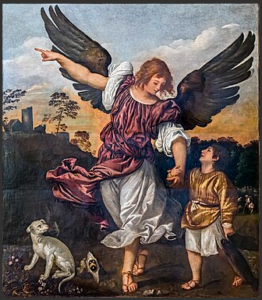
Saint Raphael the Archange, Tobias and the Dog
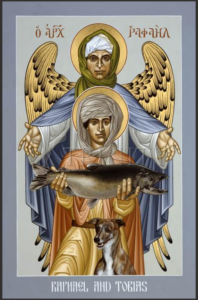
Saint Raphael the Archangel is often depicted in Christian art walking beside Tobias, the young traveler from the Book of Tobit, and a faithful dog. This charming detail comes directly from Scripture and has inspired centuries of Catholic artwork.
The Biblical Story
The story appears in the Book of Tobit (Tobit 5–12). Tobias is sent on a long journey by his father, Tobit. God sends Raphael, disguised as a traveler named Azarias, to guide and protect him.
During the journey:
- Tobias travels with Raphael for guidance.
- A small dog accompanies Tobias on the trip.
- Raphael later reveals himself as an archangel sent by God.
The dog is mentioned briefly but memorably:
“So they went forth both together, and the young man’s dog with them.” (Tobit 6:1)
Symbolism of the Dog
In Christian tradition, the dog in this story symbolizes:
- Faithfulness and companionship on the journey of life
- Divine protection, since Raphael was guiding Tobias
- Everyday life touched by God’s grace
Because of this story, many Catholic artists include the dog when portraying Raphael and Tobias.
Patronage of Saint Raphael
Saint Raphael is traditionally known as the patron saint of:
- Travelers
- Pilgrims
- The blind
- Physicians
- Healing
His name itself means “God heals.”
A Spiritual Reflection
The story reminds believers that God often sends help in quiet and unexpected ways. Just as Raphael guided Tobias step by step, Catholics believe God guides their journeys—even through ordinary companions like a faithful dog.
St. Roch
https://saintmichaelusa.org/0816-st-roch
Patron of: Plague victims, the sick, dogs
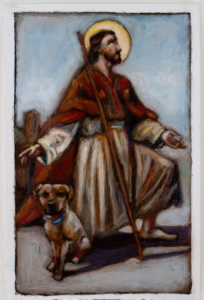
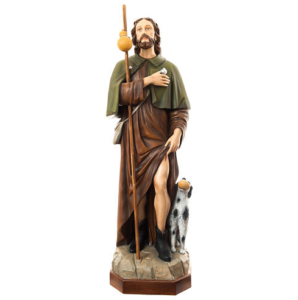
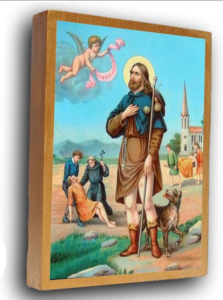
St. Roch is the most famous saint associated with a dog. While suffering from the plague and living in isolation, a dog brought him bread each day and licked his wounds, helping him survive. He is almost always shown with a dog holding bread in its mouth.
Primary Patron Saint of Dogs
St. Roch is the saint most strongly associated with dogs. According to tradition, while he was sick with the plague and living in isolation, a dog brought him bread daily and licked his wounds. Because of this miracle, he became the principal patron of dogs and is often invoked for the healing of sick pets.
Feast Day: August 16
St. Roch (also called San Rocco) is the most beloved Catholic saint associated with a dog. His story is one of suffering, abandonment, and extraordinary divine providence.
The Plague and the Forest
St. Roch was a 14th-century pilgrim who devoted his life to caring for victims of the plague. He prayed over the sick and many were miraculously healed.
Eventually, Roch himself contracted the plague. Rather than risk infecting others, he withdrew alone into the forest, prepared to die.
He was:
- Weak
- Feverish
- Covered with plague sores
- Completely alone
The Faithful Dog
According to tradition, a nobleman’s dog discovered Roch in the forest.
Each day, the dog:
- Brought him bread stolen from its master’s table
- Licked his wounds
- Stayed beside him faithfully
Through this unexpected companion, God sustained Roch until he recovered.
Eventually, the dog’s owner followed the animal into the forest, discovered Roch, and helped nurse him back to health.
Patron of: Dogs, the sick, plague victims
Feast Day: August 16
St. Roch is the most famous “saint with a dog.” After caring for victims of the plague, he contracted the disease himself and withdrew into the forest to die in solitude.
According to tradition, a loyal dog brought him bread each day and licked his wounds, helping him recover. The dog belonged to a nobleman, who later discovered Roch and helped nurse him back to health.
St. Roch’s story reminds us that:
- God provides in unexpected ways
- Creation participates in God’s mercy
- Even animals can be instruments of divine care
He is often depicted with:
- A pilgrim’s staff
- A plague wound on his leg
- A dog holding bread in its mouth
St. Dominic
Founder of: The Dominican Order
https://saintmichaelusa.org/0808-st-dominic/
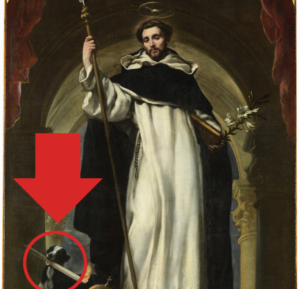
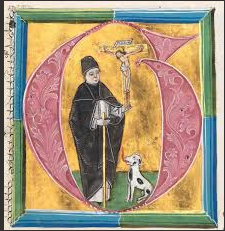
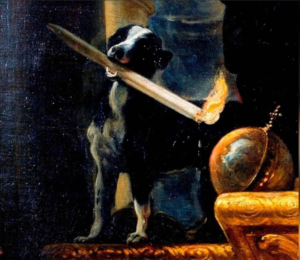
Before his birth, his mother had a vision of a dog carrying a torch in its mouth, setting the world on fire — symbolizing Dominic’s mission to preach truth. The Dominican order is sometimes symbolized by a dog with a torch (“Domini canes” — “Dogs of the Lord”).
Founder of: Order of Preachers
Feast Day: August 8
Before Dominic was born, his mother, Blessed Jane of Aza, had a dream that she gave birth to a dog carrying a torch in its mouth, setting the world on fire.
This dream symbolized:
- Dominic’s future preaching
- The spreading of the light of truth
- The Dominicans as Domini canes (“Dogs of the Lord”)
In art, a dog with a torch often appears beside St. Dominic, representing zeal for defending the faith.
St. John Bosco
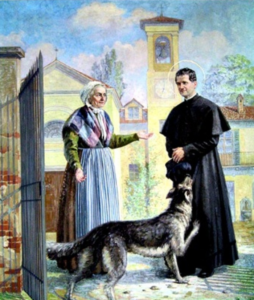
Founder of: The Salesians
https://saintmichaelusa.org/0131johnbosco/
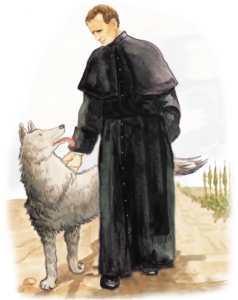
St. John Bosco (Don Bosco) was mysteriously protected by a large gray dog named Grigio. The dog appeared at key moments to defend him from danger and then vanished without explanation.
Founder of: Salesians of Don Bosco
Feast Day: January 31
Since you appreciate St. John Bosco, you may especially love this story.
St. John Bosco was mysteriously protected for many years by a large gray dog he called Grigio. The dog would appear when Don Bosco was in danger from attackers and would disappear afterward.
What makes this remarkable:
- The dog appeared suddenly and vanished mysteriously
- It lived far longer than a normal dog’s lifespan
- It never ate regularly nor belonged to anyone
Many believe Grigio was a guardian sent by God to protect Don Bosco and his mission for youth.
St. John Bosco’s connection with a dog centers on one of the most famous and mysterious episodes of his life: the repeated appearance of a large gray dog named Grigio, who protected him from attackers and may have been more than an ordinary animal.
Who Was Grigio?
Accounts from Don Bosco’s contemporaries describe a tall, powerful, wolf‑like gray dog who appeared suddenly whenever the saint was in danger. Don Bosco named him Grigio (“the gray one”). Witnesses noted that:
- He never ate, never slept at the Oratory, and vanished as mysteriously as he arrived.
- He was gentle with children, letting them climb on him or tug his ears.
- He was ferocious toward attackers, driving them off with terrifying strength.
These traits led many to believe Grigio was not a normal dog at all.
How Grigio Protected Don Bosco
Multiple documented incidents describe Grigio saving Don Bosco’s life:
- Ambush in the street: Two men threw a cloak over Don Bosco’s head to kidnap him. Grigio appeared out of nowhere, attacked both men, and forced them to flee.
- Assassin with a gun: A man fired at Don Bosco at close range and missed. Grigio immediately charged and dragged the attacker away.
- Preventing danger: On one occasion, Grigio blocked the doorway and refused to let Don Bosco leave—later it was learned that assassins were waiting outside.
These events occurred during a period when anti‑clerical hostility in Turin made Don Bosco a frequent target.
Interpretations of the Dog
The Salesian tradition offers several ways to understand Grigio:
- A real but extraordinary dog who attached himself to Don Bosco.
- A providential protector sent by God during a dangerous mission.
- A guardian angel in canine form, a belief held by many who knew Don Bosco personally.
Don Bosco himself never claimed a supernatural explanation, but he acknowledged the mystery.
Why St. John Bosco Is Depicted With a Dog
Art often shows Don Bosco with Grigio because the dog symbolizes:
- Divine protection over his mission
- Courage and steadfastness in the face of danger
- God’s care for the vulnerable, especially the boys Don Bosco served
The images above reflect how artists portray this bond—sometimes realistically, sometimes symbolically.
Summary
St. John Bosco’s dog Grigio is remembered as:
- A mysterious gray guardian
- A defender against multiple assassination attempts
- A gentle companion to the boys of the Oratory
- A symbol of God’s providence in Don Bosco’s life
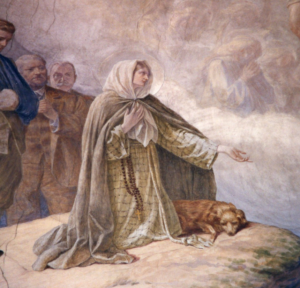
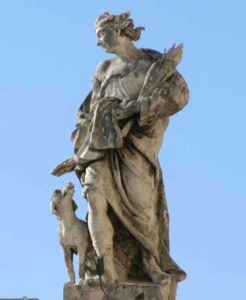
St. Margaret of Cortona
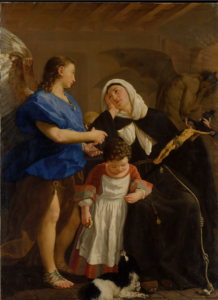
Before her conversion, a dog led Margaret to the body of her murdered lover, prompting her repentance and eventual life of holiness. She is sometimes depicted with a dog in art.
The Dog in Margaret’s Story
The key episode appears in the traditional accounts of her life:
- Margaret lived for nearly ten years with a nobleman as his mistress.
- When he failed to return from a journey, his hound came to her, tugged at her, and insisted she follow.
- The dog led her into the forest, where she discovered his body, murdered.
- This shock broke her attachment to her former life and drove her to seek forgiveness, penance, and a new beginning.
- Because of this, the dog became a symbol of God’s mercy breaking into her life, guiding her—literally—toward truth and conversion.
Why Artists Portray Her With a Dog
The dog at her feet in paintings and statues represents:
- Conversion — the moment her life changed forever.
- Faithfulness — the dog’s loyalty contrasts with the instability of her earlier life.
- Divine guidance — the animal becomes an instrument of Providence.
- Companionship — after her rejection by her family, the dog remained with her as she walked to Cortona.
This is why nearly every devotional image includes a small dog beside her habit and crucifix.
Margaret’s Life After the Dog
Once she reached Cortona, Margaret:
- Joined the Franciscan Third Order.
- Lived a life of penance, charity, and service to the poor.
- Founded a hospital and a community of women dedicated to caring for the sick.
- Became known for visions, deep prayer, and radical poverty.
She died in 1297 and was canonized in 1728.
A Quick Guide to Recognizing Her in Art
You can identify St. Margaret of Cortona by:
- A brown Franciscan habit
- A crucifix held close to her chest
- A small dog, usually at her feet
- Sometimes a skull, symbolizing penance
- A halo or rays of light indicating sanctity
If you’d like, I can also put together a side‑by‑side comparison of different artistic depictions of Margaret and her dog, or a short narrative retelling of the conversion scene.
Margaret’s Life After the Dog
Once she reached Cortona, Margaret:
- Joined the Franciscan Third Order.
- Lived a life of penance, charity, and service to the poor.
- Founded a hospital and a community of women dedicated to caring for the sick.
- Became known for visions, deep prayer, and radical poverty.
She died in 1297 and was canonized in 1728.
St. Vitus
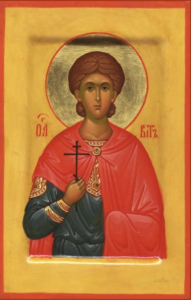
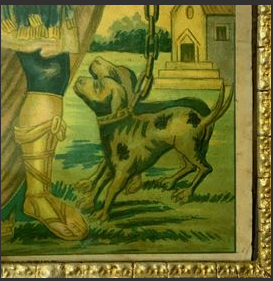
In some traditions, St. Vitus is associated with protection against rabid dogs and is occasionally shown with a dog.
Protector Against Rabies
In some traditions, St. Vitus is invoked against rabies and illnesses transmitted by dogs. Because of this, he became associated with protection from rabid dogs.
Patron of: Actors, dancers, epilepsy sufferers
Feast Day: June 15
In some traditions, St. Vitus is associated with dogs because he is invoked against rabies and animal bites. He is sometimes shown with a dog in artwork.
hy St. Vitus Is Connected With Dogs
Two strands of tradition explain the link:
1. The Rabid Dogs Legend
According to medieval accounts, during the persecutions under Emperor Diocletian, Vitus was subjected to many tortures. One story says that rabid dogs were set upon him, but instead of attacking, the dogs became calm and were healed in his presence. This miracle became a defining part of his iconography.
2. Patronage Over Dogs and Protection From Animal Attacks
Because of this legend, Vitus became known as a patron saint of dogs, and also a protector against:
- Dog bites
- Rabies
- Animal attacks in general
This patronage appears in medieval lists of the Fourteen Holy Helpers, where Vitus is invoked for protection from various dangers.
How Artists Depict St. Vitus With Dogs
In paintings, statues, and devotional medals, you’ll often see:
- A youthful saint with a halo
- A palm branch (symbol of martyrdom)
- A cauldron (another element of his martyrdom)
- One or two dogs at his feet or beside him
These dogs symbolize both the miracle and his protective patronage. Many modern medals and icons still include the dogs prominently.
Living Tradition: Blessing of the Dogs in Positano
In Positano, Italy, St. Vitus is the patron saint, and every year on June 15, the town holds a Blessing of the Dogs in his honor. People bring their pets to receive a special blessing, celebrating Vitus’s legendary compassion and protection.
Summary
St. Vitus is linked with dogs because:
- A legend says he miraculously calmed and healed rabid dogs sent to kill him.
- This led to his patronage over dogs and protection from dog-related dangers.
- Artistic depictions and living traditions (like Positano’s blessing of dogs) keep this symbolism alive.
St. Hubert
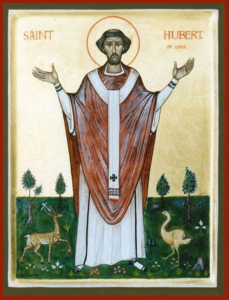
Patron of Hunters and Hunting Dogs
Though primarily the patron of hunters, St. Hubert is also associated with hunting dogs and is sometimes invoked for their protection and training.
Feast Day: November 3
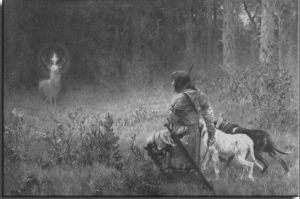
The Conversion Scene and the Dog
The most famous story about St. Hubert describes his dramatic conversion while hunting on Good Friday. As he pursued a stag, the animal turned toward him, and a glowing crucifix appeared between its antlers. In nearly all artistic depictions of this moment, a hunting dog stands beside Hubert, witnessing the miracle.
The dog symbolizes:
- Hubert’s former life as a noble hunter
- Loyalty and companionship
- The transformation of earthly pursuits into spiritual purpose
Patron Saint of Hunting Dogs
After his conversion, Hubert became bishop of Liège and later the patron saint of:
- Hunters
- Forest workers
- Hunting dogs, especially scent hounds
This patronage is so strong that the Bloodhound is still known as the “Chien de Saint-Hubert” or St. Hubert Hound, believed to descend from dogs bred at the Abbey of Saint-Hubert in Belgium.
These dogs were prized for:
- Extraordinary scent-tracking ability
- Calm temperament
- Endurance in the field
Their association with Hubert reinforced his image as protector of hunters and their animals.
How St. Hubert Is Depicted With Dogs
Artistic representations typically show:
- Hubert kneeling before the miraculous stag
- A single loyal hunting dog at his side
- Sometimes multiple hounds, depending on the region
- A forest setting, emphasizing his identity as a hunter-turned-saint
The dog is not incidental—it is a key part of the visual narrative of his conversion and patronage.
Living Traditions
In parts of Europe, especially Belgium and France, St. Hubert’s feast day (November 3) includes:
- Blessings of hunting dogs
- Processions featuring St. Hubert Hounds
- Distribution of “St. Hubert bread” for protection of animals
These customs preserve the saint’s deep connection to dogs even today
St. Francis of Assisi
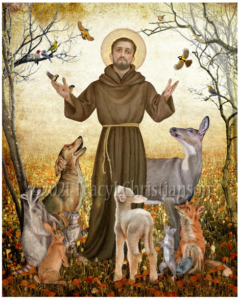
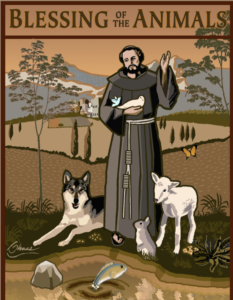
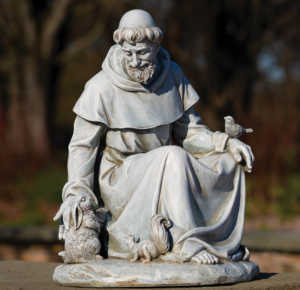
Patron Saint of Animals
https://saintmichaelusa.org/1004-St-Francis-Assisi
While not specifically the patron of dogs alone, St. Francis is the universal patron of animals and is frequently invoked for the protection and blessing of pets, including dogs.
Feast Day: October 4
National Dog Day is celebrated annually on August 26 to honor dogs of all breeds, promote adoption, and support
Key Ways to Celebrate (Aug 26):
- Adopt: Visit local shelters to save a life.
- Donate: Support rescue organizations with money, blankets, or food.
- Activity: Take your dog on a hike or to the beach.
𝗗𝗼𝗴𝘀 𝗲𝘃𝗲𝗻 𝘂𝘀𝗲𝗱 𝘁𝗼 𝗰𝗼𝗺𝗲 𝗮𝗻𝗱 𝗹𝗶𝗰𝗸 𝗵𝗶𝘀 𝘀𝗼𝗿𝗲𝘀.
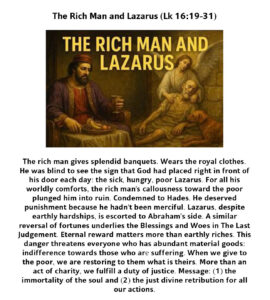
𝗚𝗼𝘀𝗽𝗲𝗹 (𝗟𝗸 𝟭𝟲:𝟭𝟵-𝟯𝟭)
𝗝𝗲𝘀𝘂𝘀 𝘀𝗮𝗶𝗱 𝘁𝗼 𝘁𝗵𝗲 𝗣𝗵𝗮𝗿𝗶𝘀𝗲𝗲𝘀, “𝗧𝗵𝗲𝗿𝗲 𝘄𝗮𝘀 𝗮 𝗿𝗶𝗰𝗵 𝗺𝗮𝗻 𝘄𝗵𝗼 𝗱𝗿𝗲𝘀𝘀𝗲𝗱 𝗶𝗻 𝗽𝘂𝗿𝗽𝗹𝗲 𝗴𝗮𝗿𝗺𝗲𝗻𝘁𝘀 𝗮𝗻𝗱 𝗳𝗶𝗻𝗲 𝗹𝗶𝗻𝗲𝗻 𝗮𝗻𝗱 𝗱𝗶𝗻𝗲𝗱 𝘀𝘂𝗺𝗽𝘁𝘂𝗼𝘂𝘀𝗹𝘆 𝗲𝗮𝗰𝗵 𝗱𝗮𝘆. 𝗔𝗻𝗱 𝗹𝘆𝗶𝗻𝗴 𝗮𝘁 𝗵𝗶𝘀 𝗱𝗼𝗼𝗿 𝘄𝗮𝘀 𝗮 𝗽𝗼𝗼𝗿 𝗺𝗮𝗻 𝗻𝗮𝗺𝗲𝗱 𝗟𝗮𝘇𝗮𝗿𝘂𝘀, 𝗰𝗼𝘃𝗲𝗿𝗲𝗱 𝘄𝗶𝘁𝗵 𝘀𝗼𝗿𝗲𝘀, 𝘄𝗵𝗼 𝘄𝗼𝘂𝗹𝗱 𝗴𝗹𝗮𝗱𝗹𝘆 𝗵𝗮𝘃𝗲 𝗲𝗮𝘁𝗲𝗻 𝗵𝗶𝘀 𝗳𝗶𝗹𝗹 𝗼𝗳 𝘁𝗵𝗲 𝘀𝗰𝗿𝗮𝗽𝘀 𝘁𝗵𝗮𝘁 𝗳𝗲𝗹𝗹 𝗳𝗿𝗼𝗺 𝘁𝗵𝗲 𝗿𝗶𝗰𝗵 𝗺𝗮𝗻’𝘀 𝘁𝗮𝗯𝗹𝗲. 𝗗𝗼𝗴𝘀 𝗲𝘃𝗲𝗻 𝘂𝘀𝗲𝗱 𝘁𝗼 𝗰𝗼𝗺𝗲 𝗮𝗻𝗱 𝗹𝗶𝗰𝗸 𝗵𝗶𝘀 𝘀𝗼𝗿𝗲𝘀. 𝗪𝗵𝗲𝗻 𝘁𝗵𝗲 𝗽𝗼𝗼𝗿 𝗺𝗮𝗻 𝗱𝗶𝗲𝗱, 𝗵𝗲 𝘄𝗮𝘀 𝗰𝗮𝗿𝗿𝗶𝗲𝗱 𝗮𝘄𝗮𝘆 𝗯𝘆 𝗮𝗻𝗴𝗲𝗹𝘀 𝘁𝗼 𝘁𝗵𝗲 𝗯𝗼𝘀𝗼𝗺 𝗼𝗳 𝗔𝗯𝗿𝗮𝗵𝗮𝗺. 𝗧𝗵𝗲 𝗿𝗶𝗰𝗵 𝗺𝗮𝗻 𝗮𝗹𝘀𝗼 𝗱𝗶𝗲𝗱 𝗮𝗻𝗱 𝘄𝗮𝘀 𝗯𝘂𝗿𝗶𝗲𝗱, 𝗮𝗻𝗱 𝗳𝗿𝗼𝗺 𝘁𝗵𝗲 𝗻𝗲𝘁𝗵𝗲𝗿𝘄𝗼𝗿𝗹𝗱, 𝘄𝗵𝗲𝗿𝗲 𝗵𝗲 𝘄𝗮𝘀 𝗶𝗻 𝘁𝗼𝗿𝗺𝗲𝗻𝘁, 𝗵𝗲 𝗿𝗮𝗶𝘀𝗲𝗱 𝗵𝗶𝘀 𝗲𝘆𝗲𝘀 𝗮𝗻𝗱 𝘀𝗮𝘄 𝗔𝗯𝗿𝗮𝗵𝗮𝗺 𝗳𝗮𝗿 𝗼𝗳𝗳 𝗮𝗻𝗱 𝗟𝗮𝘇𝗮𝗿𝘂𝘀 𝗮𝘁 𝗵𝗶𝘀 𝘀𝗶𝗱𝗲. 𝗔𝗻𝗱 𝗵𝗲 𝗰𝗿𝗶𝗲𝗱 𝗼𝘂𝘁, ‘𝗙𝗮𝘁𝗵𝗲𝗿 𝗔𝗯𝗿𝗮𝗵𝗮𝗺, 𝗵𝗮𝘃𝗲 𝗽𝗶𝘁𝘆 𝗼𝗻 𝗺𝗲. 𝗦𝗲𝗻𝗱 𝗟𝗮𝘇𝗮𝗿𝘂𝘀 𝘁𝗼 𝗱𝗶𝗽 𝘁𝗵𝗲 𝘁𝗶𝗽 𝗼𝗳 𝗵𝗶𝘀 𝗳𝗶𝗻𝗴𝗲𝗿 𝗶𝗻 𝘄𝗮𝘁𝗲𝗿 𝗮𝗻𝗱 𝗰𝗼𝗼𝗹 𝗺𝘆 𝘁𝗼𝗻𝗴𝘂𝗲, 𝗳𝗼𝗿 𝗜 𝗮𝗺 𝘀𝘂𝗳𝗳𝗲𝗿𝗶𝗻𝗴 𝘁𝗼𝗿𝗺𝗲𝗻𝘁 𝗶𝗻 𝘁𝗵𝗲𝘀𝗲 𝗳𝗹𝗮𝗺𝗲𝘀.’ 𝗔𝗯𝗿𝗮𝗵𝗮𝗺 𝗿𝗲𝗽𝗹𝗶𝗲𝗱, ‘𝗠𝘆 𝗰𝗵𝗶𝗹𝗱, 𝗿𝗲𝗺𝗲𝗺𝗯𝗲𝗿 𝘁𝗵𝗮𝘁 𝘆𝗼𝘂 𝗿𝗲𝗰𝗲𝗶𝘃𝗲𝗱 𝘄𝗵𝗮𝘁 𝘄𝗮𝘀 𝗴𝗼𝗼𝗱 𝗱𝘂𝗿𝗶𝗻𝗴 𝘆𝗼𝘂𝗿 𝗹𝗶𝗳𝗲𝘁𝗶𝗺𝗲 𝘄𝗵𝗶𝗹𝗲 𝗟𝗮𝘇𝗮𝗿𝘂𝘀 𝗹𝗶𝗸𝗲𝘄𝗶𝘀𝗲 𝗿𝗲𝗰𝗲𝗶𝘃𝗲𝗱 𝘄𝗵𝗮𝘁 𝘄𝗮𝘀 𝗯𝗮𝗱;𝗕𝘂𝘁 𝗻𝗼𝘄 𝗵𝗲 𝗶𝘀 𝗰𝗼𝗺𝗳𝗼𝗿𝘁𝗲𝗱 𝗵𝗲𝗿𝗲, 𝘄𝗵𝗲𝗿𝗲𝗮𝘀 𝘆𝗼𝘂 𝗮𝗿𝗲 𝘁𝗼𝗿𝗺𝗲𝗻𝘁𝗲𝗱. 𝗠𝗼𝗿𝗲𝗼𝘃𝗲𝗿, 𝗯𝗲𝘁𝘄𝗲𝗲𝗻 𝘂𝘀 𝗮𝗻𝗱 𝘆𝗼𝘂, 𝗮 𝗴𝗿𝗲𝗮𝘁 𝗰𝗵𝗮𝘀𝗺 𝗶𝘀 𝗲𝘀𝘁𝗮𝗯𝗹𝗶𝘀𝗵𝗲𝗱 𝘁𝗼 𝗽𝗿𝗲𝘃𝗲𝗻𝘁 𝗮𝗻𝘆𝗼𝗻𝗲 𝗳𝗿𝗼𝗺 𝗰𝗿𝗼𝘀𝘀𝗶𝗻𝗴 𝘄𝗵𝗼 𝗺𝗶𝗴𝗵𝘁 𝘄𝗶𝘀𝗵 𝘁𝗼 𝗴𝗼 𝗳𝗿𝗼𝗺 𝗼𝘂𝗿 𝘀𝗶𝗱𝗲 𝘁𝗼 𝘆𝗼𝘂𝗿𝘀 𝗼𝗿 𝗳𝗿𝗼𝗺 𝘆𝗼𝘂𝗿 𝘀𝗶𝗱𝗲 𝘁𝗼 𝗼𝘂𝗿𝘀.’ 𝗛𝗲 𝘀𝗮𝗶𝗱, ‘𝗧𝗵𝗲𝗻 𝗜 𝗯𝗲𝗴 𝘆𝗼𝘂, 𝗳𝗮𝘁𝗵𝗲𝗿, 𝘀𝗲𝗻𝗱 𝗵𝗶𝗺 𝘁𝗼 𝗺𝘆 𝗳𝗮𝘁𝗵𝗲𝗿’𝘀 𝗵𝗼𝘂𝘀𝗲, 𝗳𝗼𝗿 𝗜 𝗵𝗮𝘃𝗲 𝗳𝗶𝘃𝗲 𝗯𝗿𝗼𝘁𝗵𝗲𝗿𝘀, 𝘀𝗼 𝘁𝗵𝗮𝘁 𝗵𝗲 𝗺𝗮𝘆 𝘄𝗮𝗿𝗻 𝘁𝗵𝗲𝗺, 𝗹𝗲𝘀𝘁 𝘁𝗵𝗲𝘆 𝘁𝗼𝗼 𝗰𝗼𝗺𝗲 𝘁𝗼 𝘁𝗵𝗶𝘀 𝗽𝗹𝗮𝗰𝗲 𝗼𝗳 𝘁𝗼𝗿𝗺𝗲𝗻𝘁.’ 𝗕𝘂𝘁 𝗔𝗯𝗿𝗮𝗵𝗮𝗺 𝗿𝗲𝗽𝗹𝗶𝗲𝗱, ‘𝗧𝗵𝗲𝘆 𝗵𝗮𝘃𝗲 𝗠𝗼𝘀𝗲𝘀 𝗮𝗻𝗱 𝘁𝗵𝗲 𝗽𝗿𝗼𝗽𝗵𝗲𝘁𝘀. 𝗟𝗲𝘁 𝘁𝗵𝗲𝗺 𝗹𝗶𝘀𝘁𝗲𝗻 𝘁𝗼 𝘁𝗵𝗲𝗺.’ 𝗛𝗲 𝘀𝗮𝗶𝗱, ‘𝗢𝗵 𝗻𝗼, 𝗙𝗮𝘁𝗵𝗲𝗿 𝗔𝗯𝗿𝗮𝗵𝗮𝗺, 𝗯𝘂𝘁 𝗶𝗳 𝘀𝗼𝗺𝗲𝗼𝗻𝗲 𝗳𝗿𝗼𝗺 𝘁𝗵𝗲 𝗱𝗲𝗮𝗱 𝗴𝗼𝗲𝘀 𝘁𝗼 𝘁𝗵𝗲𝗺, 𝘁𝗵𝗲𝘆 𝘄𝗶𝗹𝗹 𝗿𝗲𝗽𝗲𝗻𝘁.’ 𝗧𝗵𝗲𝗻 𝗔𝗯𝗿𝗮𝗵𝗮𝗺 𝘀𝗮𝗶𝗱, “𝗜𝗳 𝘁𝗵𝗲𝘆 𝘄𝗶𝗹𝗹 𝗻𝗼𝘁 𝗹𝗶𝘀𝘁𝗲𝗻 𝘁𝗼 𝗠𝗼𝘀𝗲𝘀 𝗮𝗻𝗱 𝘁𝗵𝗲 𝗽𝗿𝗼𝗽𝗵𝗲𝘁𝘀, 𝗻𝗲𝗶𝘁𝗵𝗲𝗿 𝘄𝗶𝗹𝗹 𝘁𝗵𝗲𝘆 𝗯𝗲 𝗽𝗲𝗿𝘀𝘂𝗮𝗱𝗲𝗱 𝗶𝗳 𝘀𝗼𝗺𝗲𝗼𝗻𝗲 𝘀𝗵𝗼𝘂𝗹𝗱 𝗿𝗶𝘀𝗲 𝗳𝗿𝗼𝗺 𝘁𝗵𝗲 𝗱𝗲𝗮𝗱.’


Stay connected — subscribe today
https://www.youtube.com/@st.michaelusa
SIGN UP SO YOU CAN GET A BLESSING !
https://stmichaelcenter.flocknote.com/StMichaelCenter
FOLLOW US ON FACEBOOK !

https://www.facebook.com/StMichaelCenter/
MAKE A DONATION SUPPORT YOUTH & ACTIVITIES